
HR's Expensive Mistake: Component-Dominant Thinking
and what we can do differently


In the interest of providing multiple means of engaging with this blog, below is the podcast style conversation, using our AI friends Johnny and Joanne who go into each blog post at a deeper level. Or below is the usual written format which is a little more TL;DR
This week, our team fell into a familiar discussion about transformation. The conversation meandered predictably: if we want to transform the organisation, people’s behaviour needs to change. Then came the inevitable turn towards leadership and their personality profiles. If this sounds familiar, you’re not alone. This chain of reasoning reveals something fundamental about how we’ve been taught to think about organisational change—and why it so often fails.
Let me explain with a simple example. We cannot explain the behaviour of water by studying hydrogen and oxygen independently. Water’s properties—its ability to flow, freeze, or boil—emerge from the interaction of these two elements. This is what environmental psychologist Harry Heft (2013) calls an “interaction-dominant system behaviour,” where the interaction between components matters more than the components themselves.
Yet when it comes to culture change, we persist in treating organisations as “component-dominant systems.” We break behavioural change into its component parts—personality, values, experience—and explain culture by focusing on “leadership.” This is much like blaming water’s behaviour on hydrogen alone.
The Seductive Logic of Component-Dominant Thinking
There’s a reason this flawed logic persists. Component-dominant thinking follows the model of Western education: break problems down to their parts, investigate them separately, then add them back up. It’s deductive reasoning at its finest—and it works brilliantly for simple systems like snooker balls colliding on a table. One ball’s momentum transfers to another in predictable ways. Controllable. Calculable.
The problem isn’t that this approach is wrong; it’s that we’ve applied it well beyond its useful boundaries. As Heft (2013) argues, when we forget “performance-in-context” factors and the interaction-dominant nature of complex systems, “seemingly precocious performance can often be attributed to propensities ‘in’ the individual...rather than looking closely at performance-in-context” (p. 19).
This is precisely what we find ourselves doing in HR, only enhanced by Western culture’s obsession with the individual. Anyone watching football over the past decade has seen the rise of the star manager. In business, we have top 100 leaders lists. As if the performance of an organisation can be boiled down to a single component—the leader. Our fascination with simple deduction leads us to the same interventions repeatedly.

When Psychology Gave Us the Wrong Toolkit
This isn’t HR’s fault. Component-dominant thinking deduces that HR should focus on people, people are the source of behaviour, and behaviour is the source of culture. Therefore, HR is where the answer lies. So HR looks at its toolbox—perhaps the scientifically informed toolkit from psychology, cognitive science, and pedagogy. These fields, in their desire to be taken seriously, followed the “hard” sciences’ history of focusing on component-dominant ontologies.
The best experimental papers in psychology break complex behaviour down to its component parts (independent variables) and measure them against dependent variables (system behaviours). This approach assumes linear causality: change X, observe the effect on Y, whilst holding everything else constant. But as O’Sullivan et al. (2026) argue, this methodology is fundamentally mismatched to the phenomena we’re trying to understand. Traditional metrics remain “organismic (athlete as an isolated system), context-free...focused on discrete events” whilst overlooking “the situated, intentional, and relational nature of performance” (p. 3).
There are alternatives. Dynamical systems methods—such as Recurrence Quantification Analysis (RQA)—can capture the patterns of interaction over time that traditional experimental designs miss entirely. Rather than isolating variables, these approaches examine how elements of a system co-evolve and mutually influence each other across time. They can reveal the temporal structure of interactions, detect phase transitions, and identify emergent coordination patterns—precisely what we need when studying interaction-dominant systems like organisational culture.
I myself am part of this problem—I have a paper in cognitive science using precisely the traditional component-driven approach. HR then returns with component-driven, causal interventions attempting to change the hydrogen, hoping it will change the water.
The Illusion of Neat Russian Dolls
We also draw an artificial boundary around a singular, isolated culture of “the organisation.” Bronfenbrenner’s influential model of context for human development explores the various “cultures” at play with any individual at a time—nested circles from micro-systems (immediate interactions) through to macro-systems (cultural values). But as Heft (2013) warns, this image portrays a “Russian doll” aspect that suggests these levels are conceptually separable, when in fact they are not.
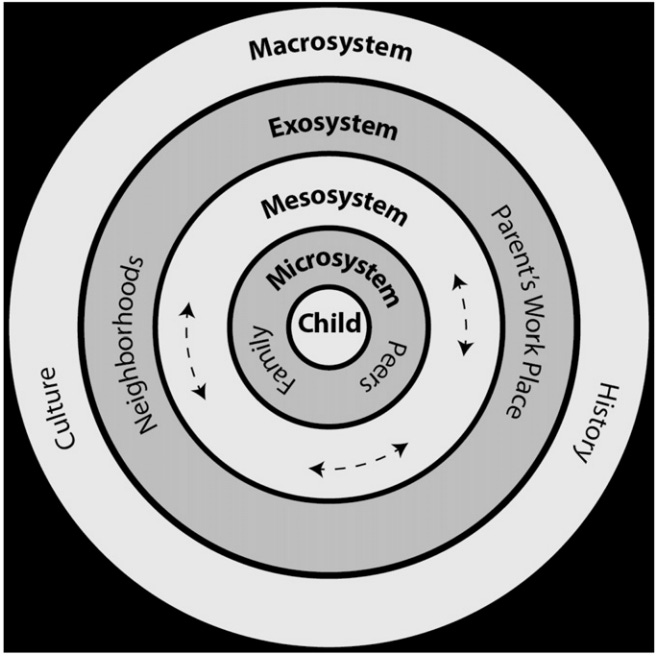
Drawing on insights from social anthropologist Tim Ingold, psychologists O’Sullivan, Manna, and Davids (2026) capture this eloquently:
“A worldview is not just what we think; it’s how we’ve learned to perceive, interpret, and act in the world. It’s embodied, often unspoken, and deeply ingrained. Worldviews guide our perception and intentionality, subtly framing what we see as possible, and often passing unnoticed as simply ‘the way things are.’” (p. 4)
Any leader is experiencing multiple cultural landscapes simultaneously—historical and future cultures shaping perception, constraining beliefs, and behaviour. When we forget these “performance-in-context” factors, we attribute outcomes to underlying competencies in the individual rather than examining how behaviour emerges from the ongoing interaction between person and environment (Heft, 2013).
The Myth of Predictability
Now, this doesn’t mean that changing component-level parts won’t change behaviour at all. If you swap hydrogen for carbon, you get carbon dioxide—a gas at room temperature that behaves completely differently from water. But here’s the critical point: you cannot predict carbon dioxide’s or water’s behaviour from studying carbon or hydrogen alone.
Anyone familiar with 3M knows that many of its biggest breakthroughs came from mistakes. That’s because chemical science, despite being component-focused in its methods, recognises it’s studying interaction-dominant systems. You cannot easily predict what will happen when elements combine. You do need to experiment and find out (EAFO).
So why do we think that if the behaviour of two compounds cannot be predicted from their component parts, we can predict the behaviour of thousands of people from different locations, ages, and backgrounds, with different (sometimes competing) goals, all nested in dynamic fields of varied places carrying different climates and eliciting different identities? Culture is no more component-dominant than water.

From Management to Experimentation
This doesn’t mean culture change is impossible or that we should abandon all efforts. But we must recognise that we’re dealing with interaction-dominant, complex adaptive systems where:
Behaviour emerges from interactions, not from individual traits alone
Relationships are constitutive, not merely causal—culture and individuals co-create each other (Heft, 2013)
Context is inseparable from the behaviour we’re trying to understand or change
Prediction is limited because small changes in conditions can lead to disproportionate effects
As O’Sullivan et al. (2026) argue for sport psychology, we need to shift from viewing individuals as isolated objects to understanding performance as emerging from “continuous dynamic interactions between players and their environment” (p. 1). The same applies to organisational behaviour.
Change management and transformation teams need to become more like 3M research facilities with exceptional ethical guardrails. We cannot “FAFO” (f*** around and find out), but we can “EAFO” (experiment and find out). This is why we need to stop using “change management” and instead embrace “change experiments.”
We cannot manage change any more than we can manage a zoo full of dinosaurs—or predict water’s behaviour from hydrogen alone. Those familiar with the Cynefin framework will recognise this as operating in complex and chaotic environments, where the relationship between cause and effect can only be understood in retrospect, and emergent practice is required.

What This Means for Practice
For HR practitioners and leaders, this shift in thinking demands:
Stop searching for root causes in individuals. When culture change fails, resist the urge to blame leadership personality or individual competence. Instead, examine the interaction patterns and environmental constraints shaping behaviour.
Design for emergence, not control. Rather than prescriptive culture programmes that attempt to install new mindsets, create conditions that make desirable behaviours more likely to emerge naturally from interactions.
Treat interventions as experiments. Acknowledge uncertainty, start small, monitor what emerges, and be prepared to adapt. Build in learning mechanisms rather than detailed implementation plans.
Attend to the environment, not just the components. What affordances does your organisational environment offer? What behaviours does it make easy or difficult? What patterns of interaction does it reinforce?
Rethink how you measure change. Move beyond static surveys that capture individual attitudes at single points in time. Look for methods that can track interaction patterns, coordination dynamics, and temporal rhythms. Ask: “How are people coordinating differently?” not just “What do individuals think?”
Embrace contextual thinking. Recognise that successful practices from one organisation cannot be copied and pasted to yours. The same intervention in a different context may produce entirely different outcomes.
The question isn’t whether we should try to influence culture—we should. The question is whether we’re humble enough to recognise that we’re working with interaction-dominant systems where behaviour emerges from relationships and contexts, not from fixing component parts.
Stop blaming hydrogen for how water behaves. Start paying attention to how the elements interact, and what that teaches us about designing better environments for the behaviours we need.
References
Heft, H. (2013). Environment, cognition, and culture: Reconsidering the cognitive map. Journal of Environmental Psychology, 33, 14–25. https://doi.org/10.1016/j.jenvp.2012.09.002
O’Sullivan, M., Manna, M., & Davids, K. (2026). Re-framing performance analysis in sport science and psychology from an ecological dynamics perspective: Toward a corresponsive, relational, and culturally situated practice. In T. Teo (Ed.), The Palgrave Encyclopedia of Theoretical and Philosophical Psychology. Springer Nature. https://doi.org/10.1007/978-3-031-70581-6_553-1